Ty the Tasmanian Tiger for the PS2, Xbox, and Gamecube.
The Low-Down On the Finest Game From the Land Down Under
Every era has it's genre, and for the the early part of this millennium, the favored game type was the 3-D action platformer. Just a few years after the innovation that Nintendo showed gamers with 1996's
Super Mario 64, other companies caught on to the particular gameplay mechanics required and ran with them, creating a long list of high-quality franchises. Most will be familiar to gamers:
Ratchet and Clank, Jak and Daxter, and
Sly Cooper, just to name the some of the more popular titles, but lurking in the background, there was always the B-list of mascot games, and most prominent among the also-rans was a little game called
Ty the Tasmanian Tiger. Perhaps it's not fair to call it an also-ran, though: when released in 2000, Ty, while not a media sensation, did manage to sell over a million copies and become a greatest hit on both Playstation 2 and Xbox, but it also singlehandedly put its developer, Krome Studios, on the map, a company whose previous “greatest accomplishment” had been Sunny Garcia Surfing. Krome went on to develop two more Ty games for the major consoles before shutting its doors just a few months ago. Ty was their only original intellectual property, and aside from a few movie-based games and Wii versions of cross-platform games, their greatest accomplishment, but what does the game look like today?
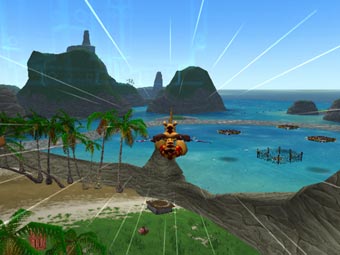
Krome was an Australian developer, and the Ty series plays on the many stereotypes associated with the land down under. If this game were your only source of knowledge on the culture and society of Australia, you might think that the country would be a strange mixture of the Wild West and the rocky surface of Mars, populated by a group of people with strange accents and frequently used supposed slang words that might even put the Crocodile Hunter to shame. Yes, the world depicted in Ty is a complete exaggeration, but whether you see it as glibly ironic or deliberately obtuse will be up to you. As you might have gathered from the title, the main character, and, indeed, all of the other characters, are anthropomorphic animals, an idea which, though normally overused, is somewhat revitalized by the species used. The menagerie here consists of Kangaroos, Koalas, Platypuses, and a variety of other Aussie animals that don't see much play in other games of this sort. The aesthetic and atmosphere, too, are quite well done: alternately desolate and vibrant, the game does a good job of conveying the beauty of the land without employing the powerful graphics that today's consoles command.

If I were to complain about anything, I suppose that it would have to be the graphics. I am a firm believer in the slogan “The graphics don't make the game,” but I realize that decade-old polygons can be off-putting for some gamers. The game isn't ugly by any means, but the early days of the PS2, Xbox, and Gamecube don't hold a candle to the processing power of today. Ty has all the hallmarks of the era: rough textures, limited draw distance, and bland will make appearances over the course of your adventure. If these are the sorts of issues that bother you, it would be best to keep that in mind when considering Ty. Another possible downside to the game are the long load times, it's not unusual to have to wait from ten to thirty seconds seconds before entering a level. Once you enter, however, there are no obvious loads while playing.
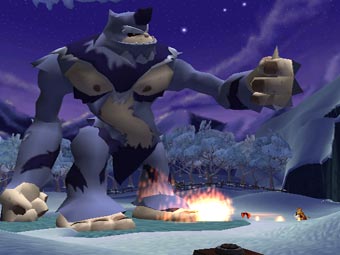
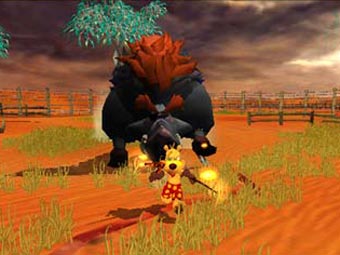
The game consists of nine main levels, four boss battles, two deathcourse levels, and one bonus level. In the main levels, you'll be tasked with assisting NPCs and gathering items to earn “Thunder Eggs.” When you earn enough of these geode-like stones, a boss portal will open and allow you the chance to move on the next area. In addition to the Thunder Eggs, you can search out additional collectibles like invisible boxes that contain concept art from the game, or gold gears (called Golden Cogs) that may be traded in for new variations on Ty's signature weapon: the boomerang. The boss levels are actually fairly innovative, with designs that surpass the typical “attack weak point for massive damage” sorts of bosses that are typically used. Each boss is well designed and distinct from the others, and the strategy you'll use to take them out won't necessarily come to you immediately. What I'm calling the deathcourses are the two final levels before the final boss battle, and unlike the main levels of the game, they contain no collectibles, and are instead focused solely on giving you a hard time. I'll talk a little bit more about the bonus in just a bit.
In general, the game plays a lot like the aforementioned
Super Mario 64: the Thunder Egg system is very similar, if not completely copied from the stars collected by the fat plumber, but Ty's outback is far from a re-skinned Mushroom kingdom. While the hardware limitations of the Nintendo 64 left Mario with an unadorned and abstract world, Ty was afforded the luxury of both structure and logic. Levels in Ty are usually very linear with a definite start and ending marked by a spawn point and a portal back to the hub world, that said, I don't think that this linearity cheapens the experience. Yes, there are typically arrows pointing you in the direction that you should probably go, but this comes off not as hand-holding but as more of a guided tour. You'll probably need to visit each of the sprawling levels several times in order to find all the collectibles, and if your first time through is just from start to finish, your second time will allow you to do a more thorough exploration of all the nooks and crannies that hide countless goodies just waiting to be found. There too, the NPC mission structure will force you to backtrack and take alternate routes that will help to relieve any repetitions, and, in addition, each area features a more open level that will have you trading the focus of the other levels for a marvelously captured sense of scale. Swimming through large swaths of the Great Barrier Reef and driving through the Outback, make for excellent changes of pace.

The story of the game isn't really anything special. Ty is out to save his family from the clutches of an evil Cassowary, and in the process, thwart the bird-brained villain's plot to take over the world with giant robots, or an alternate dimension, or something. It's not remarkably clear why any of this is happening, and if you really want to know what's going on, it would probably be best to read the instruction manual, which does a much better job of telling the back-story than does the game. At the heart of it, it's another “orphan saves the world” sort of story that's more common in Japanese Role-Playing Games than anything else, but it's serviceable here. The cut-scenes are primarily done with in-game elements and their finest feature is probably the outlandish slang and unfamiliar accents that I've mentioned before.
The true challenge of the game is not whether or not you are going to finish the game. Honestly, almost anyone with a moderate degree of skill can reach the conclusion of
Ty the Tasmanian Tiger. Even the deathcourses don't hold much of a challenge for a competent player. What may stump all but the most dedicated is 100% completion. If you want to get every Thunder Egg, every Golden Cog, help every NPC, and discover the life-increasing Rainbow Scales, you've got quite a job ahead of you. Still more time consuming is collecting each one of the 150 concept art pictures, which are so deviously placed in nearly transparent boxes. It took me over eleven hours to complete the game 100% without using any sort of guide, and I'm still lacking one of the concept art collectibles (which don't count toward your percentage). I'm afraid that I lack the strength of character to search through each of the levels all over again for that last practically invisible box. (For an idea of how hard they are to catch, see if you can find the box hidden in one of the pictures in this article.) Even that rather lengthy amount of time might not tell the whole story: that was after having played the game several times. If I had attempted a similar feat with no prior knowledge of item locations and strategies, I have no idea how long it would have taken me. The reward for getting 100% is the somewhat disappointing bonus level, which isn't really a level so much as it is a place to put an inordinate amount of picture frames. The reward for a perfect game will have to the satisfaction of job well done, because the bonus level isn't much.

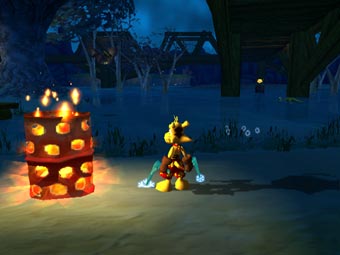
One of the nicest elements that I have yet to mention is the soundtrack. Each level features a beautiful or tense piece of music that sets the mood perfectly for the game. Not only is each track sufficiently unique, but they are all strikingly catchy. Weeks after setting the game aside, you may find yourself humming
Mangroves at Night, the theme to the Bridge Over the River Ty level. In the end, I was forced to download some of the songs for my listening pleasure. The music strikes a balance between resting in the background and drawing your attention, enhancing the experience to the fullest extent.
Perhaps you can tell that I like this game quite a bit, and for that reason I might not be the most objective person to offer my opinion of this game. Be that as it may, I think that the information I've provided in this article is sufficient to allow you to form your own opinion of the game, and you already know if this is the sort of game that appeals to your sensibilities. Granted, it does lean toward a younger audience, but the game can provide a challenge for anyone regardless of skill level or age. I especially recommend this game for children graduating to “real” games. You may have to get them through the tougher bits, but it will provide them with knowledge that will hold true for a lot of the games that they may move on to after finishing. Among the candidates for a game they might try after this one is the sequel,
Ty 2: Bush Rescue, which I will be reviewing shortly, be sure to check back for that review in a couple of weeks.
--Tom
Image Sources: Krome Studios