Friday, 31 December 2010

Alienators: Evolution Continues - Review

 Naturally Select Away From This Evolution
The Strong Survive and This Game Perishes

I'm not familiar with the 2001 film Evolution, but we have it to thank -or blame- for Alienators: Evolution Continues. Actually, Alienators is based on a short lived, animated, kids' TV show that was based on the movie, and we all know the quality of product that is churned out when a kids' show is adapted into a video game. In this case, though, Alienators is playable, and that's more than I could say for most games of this sort. The game puts you in control of Ira, a scientist/mercenary/soldier character who fills the typical hero role. The story is told in blocks of text between each of the levels, and it really doesn't matter all that much. The game could just as easily started with a message that read “There are monsters and stuff; go blow them up.” the game wouldn't have lost anything important and it would have gained style points, in my eyes, at least.

Gameplay is what you might expect: there's some shooting, there's some jumping, and there's a fair bit of collecting. As you progress through the game, you'll have to explore each of levels, collecting items as you go, before finally finding the exit and moving on. What can I say; it's a tried and true formula, and there's a reason why it's often used: it just works. There are times, though, when Alienators feels like it's a bit worn thin, especially when you stop and realize that other games have done the same things, only better. It may not be a fair comparison, but games like Mega Man ZX, Metroid: Zero Mission, and even Star Wars: Apprentice of the Force feel similar and superior to this game. Also, the controls feel loose to me, but that's a subjective gripe, so I won't dwell on it.

What is less subjective is the atrocity of the game's password feature. There is no save option in the game, if you want to put the game down for a while and then pick it back up later, you'll have to write down an eight digit password before you leave. Then, when you come back to the game, you'll have to input that password to return to your location. While it may sound like it wouldn't be a big deal, there's just no excuse for a Gameboy Advance game to not have a cartridge save feature. The only reason why a company would release a game without a save feature is to avoid having to put a battery in the cartridge, and therefore cutting the cost of each copy created. It's a penny pinching move that doesn't reflect well on the production values of the game. It wouldn't be so bad, it could even be overlooked, if the game allowed you to continue when you die, but as it is, you'll have to re-input the password every time you die: more often than you might think considering the fact that enemies respawn while health items do not.


While I might not call the graphics beautiful, I must say that I have a soft spot for sprites, and the game provides passable visuals. The enemies might not have the most original designs, but they're all good looking, and the backgrounds aren't bad either. The music is fine, if a little repetitive on the menus, but the music on the levels ranges from alright and repetitive to mind numbingly annoying and repetitive. Sound effects aren't anything to write home about: just about typical.

Come to think of it, if I were to use one word to describe this game, it would probably be “typical.” There's not a lot here that you haven't seen before in other, better games. I don't think there's anything here that needs to be played unless the Alienators TV show holds some sort of nostalgic appeal to you. If you want to prove me wrong, though, you won't have to break the bank to get your hands on a copy of the game. If you shop around a bit, you can find Alienators: Evolution Continues for around $5, but if you take my advice, you'll steer clear of this game.

--Tom

Alien Hominid - Review

 Short and Sweet
Intergalactic Crash Landing: Fun Ensues

Newgrounds is a website well known for games, but the games that populate its servers are typically of the flash variety, nothing like commercial products of any sort. It was, therefor, quite a surprise for me when I noticed the Newgrounds logo slapped onto the charming shooter for the Gameboy Advance, Alien Hominid. Had I been more familiar with the Alien Hominid brand, I would have known that the game debuted as a flash game that was featured on the aforementioned site and racked up over 19 million plays. The developers, an ironically small company known as The Behemoth, adapted and improved their successful flash game and released Alien Hominid for the Xbox, Playstation 2, and Gamecube in the latter part of 2004. Another small game developer, Tuna Technologies, was hired to port the game to the GBA, and the result is the game whose review you now happen to be reading.

Usually, I'm rather hard on commercially released sequels or adaptations of flash games, but in this case I think that the game was improved enough to warrant the cost. The game plays as what I'm tempted to call a “typical” side-scrolling shooter, but, really, there aren't enough games in this genre to dismiss the mechanics as typical. I should say that the control in Alien Hominid is very tight, reminiscent of games like Metal Slug or Gunstar Heroes. You should have no trouble maneuvering your little yellow alien through the game world, blowing the heads off of FBI agents and Soviet soldiers as you go. If there's one thing this game is not afraid to do, it's make a spectacle: clever boss battles range from giant sand monsters to an assortment of large robots, and copious amounts of blood burst from every grunt you take down. The gore can be turned off, but honestly: why would you? It might not quite fit the definition of epic, but it's certainly reaching toward that goal.


What may not be quite so epic is the game's story mode. Every once in a while, you'll watch a couple of still frames and get the general gist of what's going on, but the story really only exists to fit the segments together. Nuclear war, Area 51, Yeti, and, of course, Aliens are all crammed in to the mixture without a whole lot of explanation, but you probably won't need it either. In a title like this that is all about the gameplay, I found that the disparate elements that are introduced without ceremony, flow together to create a game that doesn't seem to be taking itself seriously. There are no moral quandaries to be considered in Alien Hominid, there is no time to stop and think about the wives and children of the endless waves of FBI agents that you'll be murdering, there is only nonstop action, and for that, I've got to commend the game.

What I can't commend the game for is its length. It took me less than two hours to see everything that Alien Hominid has to offer, and a playthrough of the main game itself will take less than an hour. Shelf life is somewhat extended by the inclusion of three minigames, but even these are a bit of a let-down. Coming off as little more than simplistic flash-esque games themselves, the minigames probably won't occupy you for very long. If you're going to reap continued enjoyment from this game, you'll have to be willing to put in multiple playthroughs, a possibility that is nicely enhanced by the well-implemented difficulty settings which do a good job of making the game accessible without compromising the rest of the game. You'll have to play on medium or hard if you want to see all of the levels the game has to offer.


The music is somewhat forgettable, and I could go on with nit-picky details like my hatred of the way you're forced to hide in level 3-1, or the awkward spaceship levels at the end of the first two worlds, but those are forgivable faults. The important thing is that the game is fun, and if you're willing to put up with the fact that there are only 12 levels, there's no real reason why you should pass this game up. The only difficulty might be the availability of the cartridge: the game was only released for the Gameboy Advance in Europe, so you might have to do some looking around before you're able to dig up a copy. Used copies do occasionally show up on Ebay and Amazon, though, and the prices are typically in the mid range of around $10. It may have its flaws, but if what I've said here doesn't sway you, feast your eyes on some gameplay footage and tell me what you think in the comment section below.

Alien Hominid Gameplay
More Alien Hominid Gameplay

--Tom

Wednesday, 22 December 2010

Ty the Tasmanian Tiger - Review

Ty the Tasmanian Tiger for the PS2, Xbox, and Gamecube.
The Low-Down On the Finest Game From the Land Down Under

Every era has it's genre, and for the the early part of this millennium, the favored game type was the 3-D action platformer. Just a few years after the innovation that Nintendo showed gamers with 1996's Super Mario 64, other companies caught on to the particular gameplay mechanics required and ran with them, creating a long list of high-quality franchises. Most will be familiar to gamers: Ratchet and Clank, Jak and Daxter, and Sly Cooper, just to name the some of the more popular titles, but lurking in the background, there was always the B-list of mascot games, and most prominent among the also-rans was a little game called Ty the Tasmanian Tiger. Perhaps it's not fair to call it an also-ran, though: when released in 2000, Ty, while not a media sensation, did manage to sell over a million copies and become a greatest hit on both Playstation 2 and Xbox, but it also singlehandedly put its developer, Krome Studios, on the map, a company whose previous “greatest accomplishment” had been Sunny Garcia Surfing. Krome went on to develop two more Ty games for the major consoles before shutting its doors just a few months ago. Ty was their only original intellectual property, and aside from a few movie-based games and Wii versions of cross-platform games, their greatest accomplishment, but what does the game look like today?

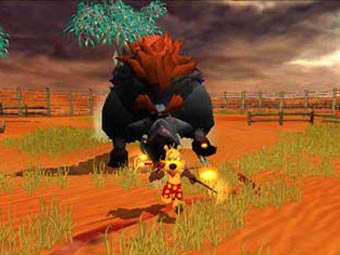
Krome was an Australian developer, and the Ty series plays on the many stereotypes associated with the land down under. If this game were your only source of knowledge on the culture and society of Australia, you might think that the country would be a strange mixture of the Wild West and the rocky surface of Mars, populated by a group of people with strange accents and frequently used supposed slang words that might even put the Crocodile Hunter to shame. Yes, the world depicted in Ty is a complete exaggeration, but whether you see it as glibly ironic or deliberately obtuse will be up to you. As you might have gathered from the title, the main character, and, indeed, all of the other characters, are anthropomorphic animals, an idea which, though normally overused, is somewhat revitalized by the species used. The menagerie here consists of Kangaroos, Koalas, Platypuses, and a variety of other Aussie animals that don't see much play in other games of this sort. The aesthetic and atmosphere, too, are quite well done: alternately desolate and vibrant, the game does a good job of conveying the beauty of the land without employing the powerful graphics that today's consoles command.
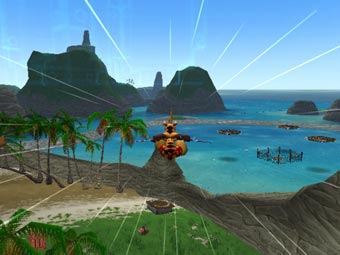

If I were to complain about anything, I suppose that it would have to be the graphics. I am a firm believer in the slogan “The graphics don't make the game,” but I realize that decade-old polygons can be off-putting for some gamers. The game isn't ugly by any means, but the early days of the PS2, Xbox, and Gamecube don't hold a candle to the processing power of today. Ty has all the hallmarks of the era: rough textures, limited draw distance, and bland will make appearances over the course of your adventure. If these are the sorts of issues that bother you, it would be best to keep that in mind when considering Ty. Another possible downside to the game are the long load times, it's not unusual to have to wait from ten to thirty seconds seconds before entering a level. Once you enter, however, there are no obvious loads while playing.

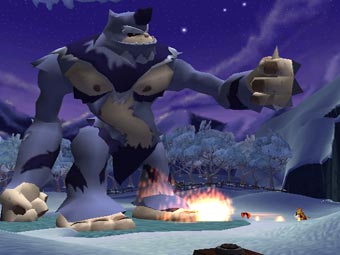
The game consists of nine main levels, four boss battles, two deathcourse levels, and one bonus level. In the main levels, you'll be tasked with assisting NPCs and gathering items to earn “Thunder Eggs.” When you earn enough of these geode-like stones, a boss portal will open and allow you the chance to move on the next area. In addition to the Thunder Eggs, you can search out additional collectibles like invisible boxes that contain concept art from the game, or gold gears (called Golden Cogs) that may be traded in for new variations on Ty's signature weapon: the boomerang. The boss levels are actually fairly innovative, with designs that surpass the typical “attack weak point for massive damage” sorts of bosses that are typically used. Each boss is well designed and distinct from the others, and the strategy you'll use to take them out won't necessarily come to you immediately. What I'm calling the deathcourses are the two final levels before the final boss battle, and unlike the main levels of the game, they contain no collectibles, and are instead focused solely on giving you a hard time. I'll talk a little bit more about the bonus in just a bit.

In general, the game plays a lot like the aforementioned Super Mario 64: the Thunder Egg system is very similar, if not completely copied from the stars collected by the fat plumber, but Ty's outback is far from a re-skinned Mushroom kingdom. While the hardware limitations of the Nintendo 64 left Mario with an unadorned and abstract world, Ty was afforded the luxury of both structure and logic. Levels in Ty are usually very linear with a definite start and ending marked by a spawn point and a portal back to the hub world, that said, I don't think that this linearity cheapens the experience. Yes, there are typically arrows pointing you in the direction that you should probably go, but this comes off not as hand-holding but as more of a guided tour. You'll probably need to visit each of the sprawling levels several times in order to find all the collectibles, and if your first time through is just from start to finish, your second time will allow you to do a more thorough exploration of all the nooks and crannies that hide countless goodies just waiting to be found. There too, the NPC mission structure will force you to backtrack and take alternate routes that will help to relieve any repetitions, and, in addition, each area features a more open level that will have you trading the focus of the other levels for a marvelously captured sense of scale. Swimming through large swaths of the Great Barrier Reef and driving through the Outback, make for excellent changes of pace.

The story of the game isn't really anything special. Ty is out to save his family from the clutches of an evil Cassowary, and in the process, thwart the bird-brained villain's plot to take over the world with giant robots, or an alternate dimension, or something. It's not remarkably clear why any of this is happening, and if you really want to know what's going on, it would probably be best to read the instruction manual, which does a much better job of telling the back-story than does the game. At the heart of it, it's another “orphan saves the world” sort of story that's more common in Japanese Role-Playing Games than anything else, but it's serviceable here. The cut-scenes are primarily done with in-game elements and their finest feature is probably the outlandish slang and unfamiliar accents that I've mentioned before.

The true challenge of the game is not whether or not you are going to finish the game. Honestly, almost anyone with a moderate degree of skill can reach the conclusion of Ty the Tasmanian Tiger. Even the deathcourses don't hold much of a challenge for a competent player. What may stump all but the most dedicated is 100% completion. If you want to get every Thunder Egg, every Golden Cog, help every NPC, and discover the life-increasing Rainbow Scales, you've got quite a job ahead of you. Still more time consuming is collecting each one of the 150 concept art pictures, which are so deviously placed in nearly transparent boxes. It took me over eleven hours to complete the game 100% without using any sort of guide, and I'm still lacking one of the concept art collectibles (which don't count toward your percentage). I'm afraid that I lack the strength of character to search through each of the levels all over again for that last practically invisible box.  (For an idea of how hard they are to catch, see if you can find the box hidden in one of the pictures in this article.) Even that rather lengthy amount of time might not tell the whole story: that was after having played the game several times. If I had attempted a similar feat with no prior knowledge of item locations and strategies, I have no idea how long it would have taken me. The reward for getting 100% is the somewhat disappointing bonus level, which isn't really a level so much as it is a place to put an inordinate amount of picture frames. The reward for a perfect game will have to the satisfaction of job well done, because the bonus level isn't much.

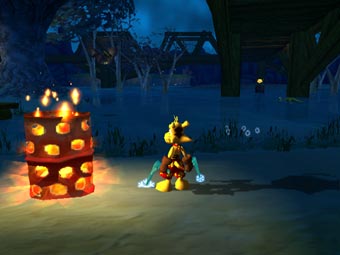
One of the nicest elements that I have yet to mention is the soundtrack. Each level features a beautiful or tense piece of music that sets the mood perfectly for the game. Not only is each track sufficiently unique, but they are all strikingly catchy. Weeks after setting the game aside, you may find yourself humming Mangroves at Night, the theme to the Bridge Over the River Ty level. In the end, I was forced to download some of the songs for my listening pleasure. The music strikes a balance between resting in the background and drawing your attention, enhancing the experience to the fullest extent.

Perhaps you can tell that I like this game quite a bit, and for that reason I might not be the most objective person to offer my opinion of this game. Be that as it may, I think that the information I've provided in this article is sufficient to allow you to form your own opinion of the game, and you already know if this is the sort of game that appeals to your sensibilities. Granted, it does lean toward a younger audience, but the game can provide a challenge for anyone regardless of skill level or age. I especially recommend this game for children graduating to “real” games. You may have to get them through the tougher bits, but it will provide them with knowledge that will hold true for a lot of the games that they may move on to after finishing. Among the candidates for a game they might try after this one is the sequel, Ty 2: Bush Rescue, which I will be reviewing shortly, be sure to check back for that review in a couple of weeks.

--Tom

Image Sources: Krome Studios

Tuesday, 21 December 2010

Metroid Prime: Why it's the best thing since sliced bread.


If there's ONE thing, ONE thing I like better than Portal, it's Metroid Prime. Retro Studios's 2002 title is not only the best Metroid games, not only the best Gamecube game, not only the best Nintendo game, but the best damn game in the history of platformers. Weapons, gameplay, music, even story!


THE STORY

The story begins with Samus intercepting a distress signal from the Frigate Orpheon, a space pirate research ship. She soon finds all of it's crew dead, or seriously injured. Further exploration finds the Parasite Queen, a giant bug thing hanging above the core. She soon dispatches it, and it falls into the core, causing a countdown timer to start. As Samus is leaving, she comes across Meta Ridley, a reincarnation of her old foe. Meta Ridley escapes, and as Samus is pursing him, a blast of electrical energy knocks Samus's powerups offline. She chases Meta Ridley to Tallon IV, a planet which has been impacted by a meteor containing Phazon, a deadly blue substance with incredible destructive properties. She lands on Tallon IV, and sets out to discover the Pirates' true intention.

THE GAMEPLAY

The gameplay is a lot different from most First Person games, and it bears lots of similarities to Half Life, except it's not as combat oriented, and the puzzles are a lot shorter. To jump, you hit B, and to fire, you hit A. Missiles are fired with the Y (Or D-Pad up, if you're playing the Wii version), Morph Ball is X (Or C if you're on the Wii), L (Or Z) locks on, and R allows freeview (GC only). All the controls feel natural, and are very quick and responsive. A lot of reviewers don't like the lack of dual sticks, but who cares? It plays like a dream. The power ups are the basic Metroid stuff, Varia suit, Ice beam, bombs, missiles, etc. All of them control like they do in the 2D games. Only thing is, they don't stack, so you have to choose them individually.
The biggest addition is visors, with a main visor, scan visor (Which allows you to scan enemies and computers for information), a thermal visor, an X ray visor, etc.

THE MUSIC

Holy mother of crap is it awesome. Just listen to the music on the right! It's fricken amazing! It mostly consists of remixes from old games, Lower Norfair being the Magmoor Caverns theme, Brinstar being the first Tallon Overworld theme (It switches to some other track when you acquire the Spider Ball) All of the tracks are beautifully made, and sometimes I had paused the game just to listen to it! It's that well done!


THE FINAL WORD

Buy it. NOW. It's the best damn game on the Wii/Gamecube. Final score, 9000 out of 10.

Monday, 20 December 2010

The Best Multiplayer This Year - Part 1


So, what have you played the most this year? It's unlikely that you trawled through Final Fantasy XIII and a large plethora of J-RPG's so i'm gonna go out on a limb and say multiplayer. Going mano a mano against real people, just usually with guns.

There has been so many good multiplayer titles this year, but lets start from the top. Unfortunately i can only include games I've either played or heard a lot about, so some obscure titles possibly won't make it to the list.

January

MAG (Massive Action Game)


This is a game that really play's up to it's name. Intense 250 player online matches that seem like warzones, objective based missions that break people into teams inducing tactical play and... Well, 250 players, need i say more? I mean that's amazing. The only problem is, released back in January, you could have a tough time finding a 250 player game now with all the other quality titles that have come out this year.


February

Bioshock 2


To many this may just seem to be a tacked on multiplayer to enhance the overall experience. But the Bioshock multiplayer managed to bring a lot to the table, and all in a typically Bioshock like manner. Plasmids were included to help turn the tide of battle, Big daddy suits were available first come first served, and a sprawling narrative opened up of your character within the uprising before the original Bioshock as you played. Now that's just classy. Hopefully there's still players about so you can still experience the magic. Sorry, the adam *giggle and gafore*


March

Battlefield: Bad Company 2


I can't explain this multiplayer to you without the phrase "Holy Shit!" The aim of the game? Destroy the enemy teams pot's o' gold. How? By any means necessary, in this game, you'll get things done. Any structure is destructible, so an enemy in a tank is a real situation, you can't sit tight and hold for the best, oh no, you have to take that thing out before your base crumbles! I've never found a more intense multiplayer experience than the Bad Company series. The frostbite engine really does itself justice with the demolishing mechanics, this is FPS multiplayer at it's finest. Oh, did i also mention the class system is awesome, and the focus on team play really helps to get people tactical? It's just brilliant.


Fat Princess: Fistful of cake!


This game was brilliant on the Play Station Network last year, but the updated and refined PSP release just takes the cake... No pun intended? Please! The multiplayer is completely different in Fat Princess, although it can be summed up to a game of capture the flag, it's much much more! The enemy have your princess, and you have theirs. You both want your princess back, unfortunately for the kingdoms, the negotiator is out that day, so it's all out war on the other kingdom to get your princess back until he get's back! How do you stop the other team getting their princess back? By feeding her cake of course! The more you feed her, the fatter she gets, the fatter she gets, the harder she is to carry... It's a fantastic idea that includes resource collecting, classes and most importantly a heavy focus on teamwork! There is also the psn original Fat Princess which is by no means worse, pick up an entry to this series, you won't regret it.


Perfect Dark

Well what can you say? It's Perfect Dark! The N64 classic that highlighted the N64 as a multiplayer platform along with another certain title by the same company. This game defined console shooters, and deserves recognition for this, although the rezed up single player isn't as good as I remember, the multiplayer is still some of the best around. Hell, it's only 800 Microsoft-Points, why not grab it now?


April

Splinter Cell: Conviction


Two players max, sure. But you can't fault it. Conviction's multiplayer is solid, and not only contains a rich co-op experience that has a fantastic twist at the end, but also a plethora of modes to play with. One has you trying to take out the other player as stealthily as possible whilst guards patrol the map ready to shoot and kill whoever they may see. Another see's the player's working together to survive, yes, a horde mode, but still. The Splinter Cell formula gives these the spice of life, and since you only need a friend, there's no excuse not to try this one out!

Keep an eye out for part 2! (May-August)

-Serde

Image credit: 1up.com, Pocket-lint.com, Gamernode.com, modtv1337.com, bitmob.com, videogamesblogger, incgamers.com


The Arcade of Anime?

Are we changing our name?

Short answer, no.

However, in the "Arcade of Anime" article's we'll be looking at games that are to be imported here from japan.

Why "Arcade of Anime" then? Because the name has a nice ring to it!


The 3rd Birthday
___________
Format(s): psp


The first game we're going to take a look at is the third, and latest installment in the parasite eve series, the second of which was released back on the playstation one. Square Enix describes the game as a "cinematic action rpg" which is all well and good considering the game is within an rpg series that was made to be cinematic, featured role playing elements and focused on action. The change however is that the battle system from the first two games has been ripped out and replaced with 3rd person shooting. Now, i'm fine with this, but on the psp? I understand that there have been "successes" in the 3rd person shooting arena on the psp with the likes of resistance: retribution and the syphon filter series, however they were still "good... For the psp". I guess it's a big risk revamping a decade old series that wasn't the best recieved, so the cheaper handheld route has to be the way they go. I digress, the set-up for the game is that beasts have descended on manhattan, and it's up to our protagonist Aya to defend the place. Watch this space for more details before the game hits our stores in May 2011

Ghost Trick
_________________
Format(s): Nintendo DS


Ghost Trick - Phantom Detective is a game from Capcom that centres around our friendly neighbourhood Sissel. He's... Well, he's a bit dead. Now don't you think this'll stop him though as our Sissel, he's up for a challenge. So he decides to dedicate the rest of his ghostly life to helping protect the lives of innocent people, the alive ones that is. All in the meantime he is trying to find out how he died, and why. The story is said to be quite gripping, and it sounds like it'll hold anyone to the edge of their... DS? The gameplay takes the form of a murder mystery. Each level, someone has been killed and it's up to the player to prevent that death. Sissel can travel back 4 minutes prior to the killing within a small radius to try and stop it, and can also posses inanimate objects with his ghostly powers. It all sounds very interesting, and i can't wait to have a go. Out in Japan right now if you fancy importing, Ghost Trick is out in the west in Mid January! Keep an eye out.


Thus concludes this Arcade of Anime!

Seeya folks!

-Serde

Image credit: gamerfront.com, gamerant.com

Saturday, 18 December 2010

Pac-Man Pinball Advance - Review


Pac-Man Plays Pinball
Not Quite Amazing

Few of the Arcade greats had easy transitions to modern gaming. The video game industry was forced to make a huge departure from the primarily coin-operated market of the late 70's and early 80's, moving to the home console-driven market of the late 80's to the present day. Some stars of the arcade days, like Donkey Kong, went into the new market almost seamlessly with high-profile games like Donkey Kong Country that established them in the modern era as viable mascots, and for a while there, it seemed like if anyone were to succeed, Namco's Pac-Man would. Pac-Man's enormous popularity allowed him to overcome missteps like Pac-Man on the 2600 or Pac-Man 2 on the SNES and Genesis, and the lovable yellow dot even managed to successfully cross over the 2D-3D divide in 1999's Pac-Man World. However, the last decade hasn't been very kind to Namco's hungry, hungry spheroid, and after a long parade of spin-off titles, Pac's reputation isn't quite what it used to be. While the recent Pac-Man Championship Edition DX has been receiving rave reviews, we're not talking about that game today. Instead, we've got one of those dreaded spin-offs: Pac-Man Pinball Advance.

I would like to think of myself as an open minded guy, and I was willing to enjoy Pac-Man pinball as nonthreatening, kid-friendly pinball game for the younger-skewing Gameboy Advance, but sometimes games don't even give you the chance to like them. The game starts off with a none-too-pretty cut-scene that seems to be comprised of low-resolution, 2D elements from Pac-Man World 2. The story is the same kidnapped family tale that was told in the first Pac-Man World, but, really, a story isn't necessary in a pinball game. The point of pinball is to play the game, and you'll be supplied with two different boards to do just that. Each board includes alternate a night version that is essentially a new skin of the same board with a blue color scheme.


As is so often my complaint with cheaply made pinball games, the physics of Pac-Man Pinball Advance just don't seem like they've been refined. The flippers aren't able to get the ball up to speed half the time and the speed of the ball doesn't seem to be correctly fitted to the rest of the gameplay. The boards, too, seem like they weren't well designed for the way the game is played, with many of the objectives purely luck based and deadly gutters that are diabolically placed in a such a way that you're only ever a couple of bumpers away from loosing. These factors add up to make the game seem like it's less about the core skills of pinball and more about just hitting the ball around and hoping that something will happen.

I can speak positively about the music, though. Taking inspiration from the sound-tracks of the first two Pac-Man World games, the music is suitable different but comfortably similar to what we've heard before, never overstated, but not noticeably enjoyable either. It is, to some extent, just there, but it's not bad. The game also has some nice features like multi-ball, functional store system, and he nice touch of a ghost eating mode, but these are outweighed by the almost unforgivable lack of a high-score table.

I don't think there are any hard-core Pac-Man fans to whom I can recommend this game, but if there are, I have to wonder how they explain the last ten years of Namco trying to use Pac-Man as a cash cow for mediocre games like this one. The game can be found for five to ten dollars, but I can think of no good reason why you need to search out a copy. If you find yourself feeling the need for a power-pellet or two, stick with the classics, there's no need to turn to Pac-Man Pinball Advance.